
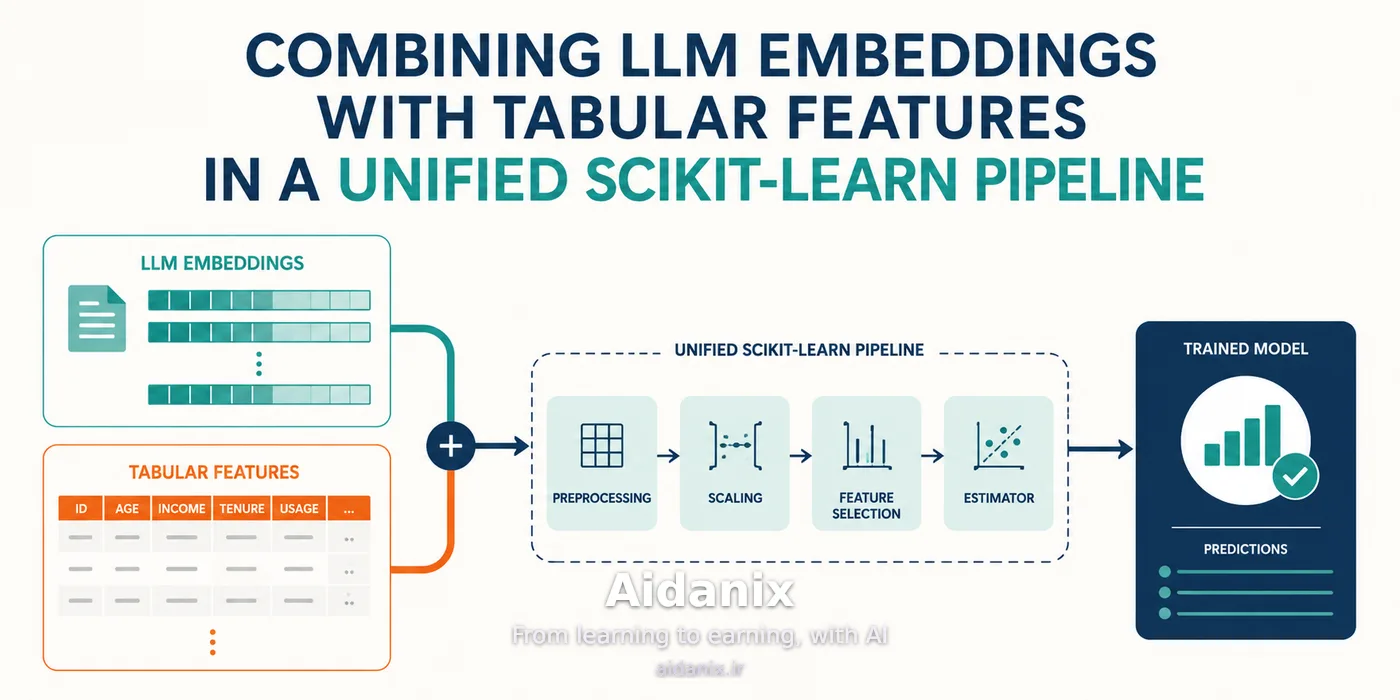
This article presents a practical method for building an integrated pipeline using the scikit-learn library, in which textual outputs generated by a lightweight, open-source language model are processed in coordination with structured (tabular) features. This approach enables leveraging the capabilities of large language models (LLMs) within traditional machine learning workflows, without relying on the common “generate once, reuse never” pattern.
The primary objective of this architecture is to overcome the limitations of lightweight APIs, which typically suffer from low speed or high costs. By integrating these two data sources into a unified framework, the final model can simultaneously benefit from deep linguistic context and precise numerical structures, potentially improving prediction accuracy in more complex tasks. This method provides a powerful tool for researchers seeking rapid, reproducible experiments without requiring heavy GPU infrastructure.