
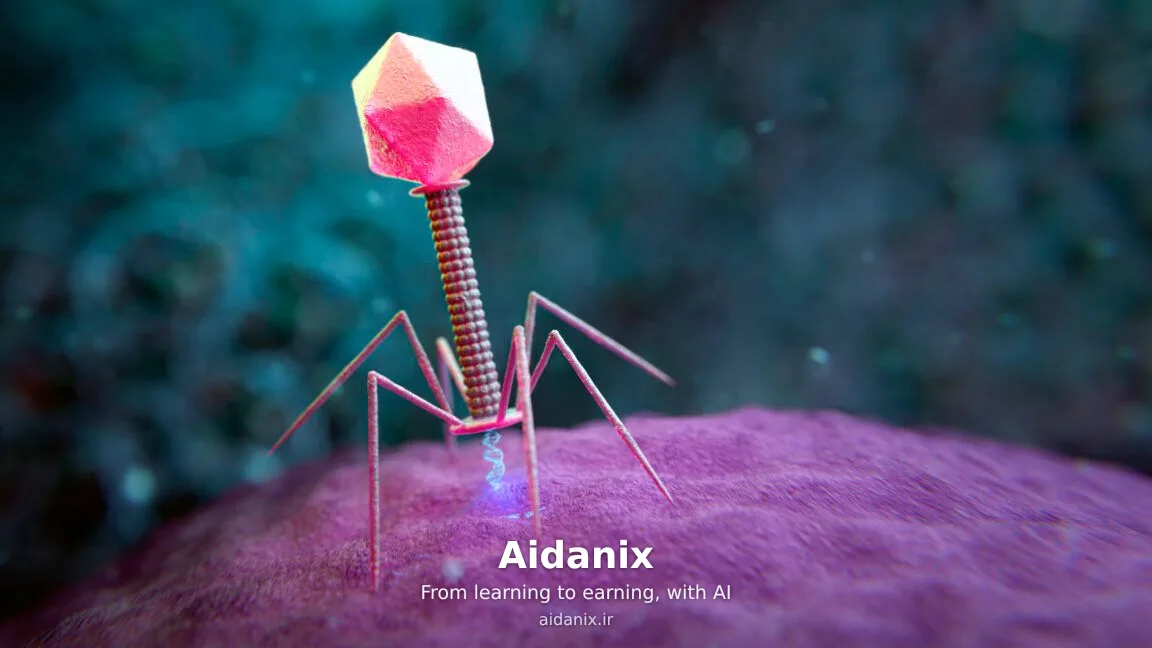
Until now, a major portion of artificial intelligence activities in the field of biology had focused on protein design, as proteins are primarily responsible for cellular structure and vital chemical reactions. However, a new generation of technology known as "Large Genome Models" (LGMs) has shown that AI can go beyond proteins and work directly with DNA codes.
Large Genome Models, trained on trillions of base pairs, had previously proven their ability to reconstruct complex gene structures and encode functional proteins in bacteria. Now, researchers at Stanford University have used these models to generate the complete genomes of viruses that infect bacteria.
Although the AI-generated viruses closely resemble those found in nature, they possess distinct characteristics whose evolution in nature would not be easily possible. Researchers warn that this scientific achievement highlights the necessity of considering measures to counter potential risks, as versions of this AI might be developed in the future that possess the capability to design targeted viruses for vertebrates and humans.